


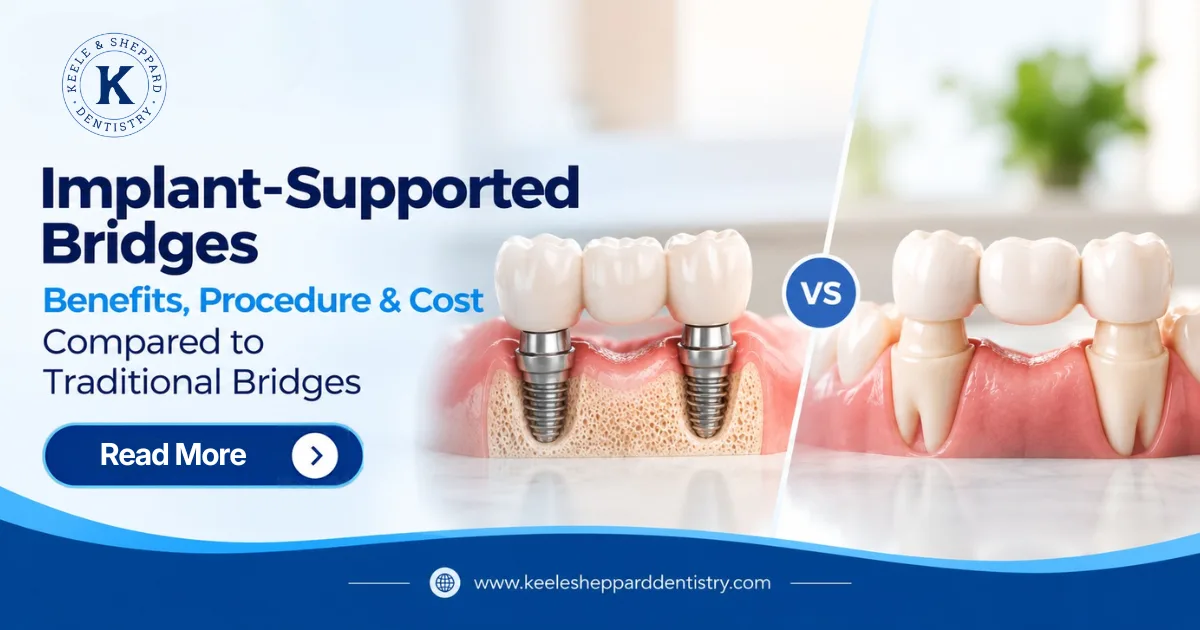
| The Short Answer: Implant-supported bridges replace a row of missing teeth using implants as anchors, instead of grinding down natural teeth the way a traditional bridge does. They protect bone and neighbouring teeth, last well with care, and cost more upfront. In North York, suitability and implant-supported bridge cost are confirmed at a consultation. |
Missing several teeth in a row leaves you with two main fixed options: a traditional bridge or an implant-supported one. They solve the same problem very differently. This dental bridge vs implant bridge guide compares implant-supported bridges with traditional bridges on benefits, procedure, and cost, so you can choose with confidence.
This article is for general information and is not a substitute for a dental exam.
What Is an Implant-Supported Bridge?
An implant-supported bridge replaces a row of missing teeth by anchoring the bridge to implants placed in the jaw, rather than to your natural teeth. Typically, two or more implants carry a bridge of three or more teeth between them.
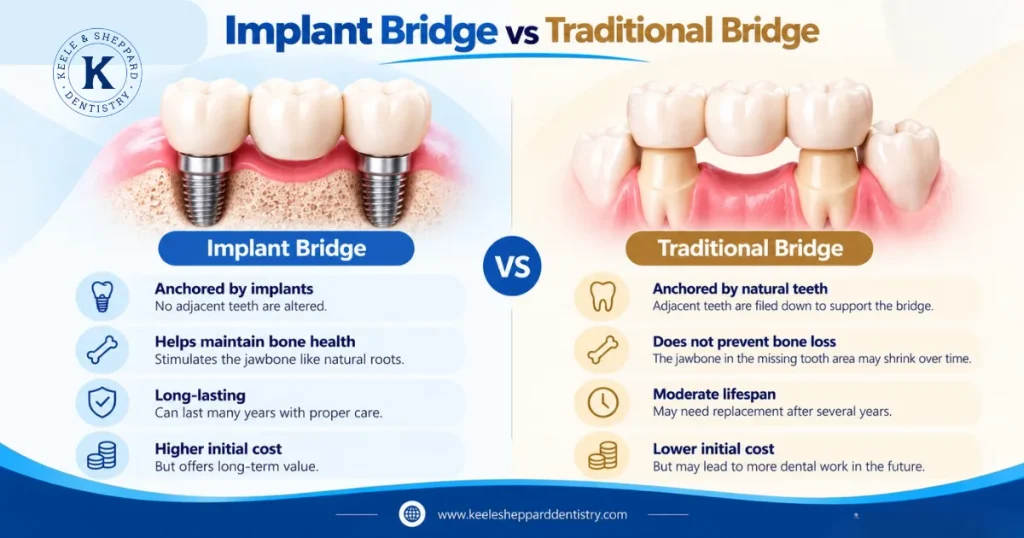
The key difference from a traditional bridge is what carries the load. A traditional bridge rests on the two natural teeth either side of the gap, which must be filed down to serve as anchors. An implant bridge stands on its own implants, so your healthy neighbouring teeth stay untouched, and the implants keep stimulating the jawbone beneath the gap.
Implant-Supported Bridge Benefits
The implant-supported bridge benefits that matter most:
- Neighbouring Teeth Stay Whole, with no healthy enamel ground away to anchor the bridge.
- Bone Is Preserved, since the implants stimulate the jaw where teeth are missing.
- Strong, Stable Chewing that feels close to natural teeth.
- Long-Lasting, often outlasting traditional bridges when cared for well.
- Fewer Teeth at Risk, because the bridge doesn’t depend on the health of filed-down anchor teeth.
The Side-By-Side Comparison Between Implant Supported Bridge and Traditional Bridge
| Factor | Implant-Supported Bridge | Traditional Bridge |
|---|---|---|
| Anchors | Dental implants | Natural teeth, filed down |
| Neighbouring Teeth | Left untouched | Ground down to hold the bridge |
| Bone Health | Implants preserve jawbone | Bone shrinks beneath the gap |
| Longevity | Often longer with good care | Typically needs replacing sooner |
| Upfront Cost | Higher | Lower |
| Treatment Time | Longer, includes healing | Faster, usually a few weeks |
| Surgery | Yes, implant placement | No surgery |
The full picture of how implants compare with other routes is in our guide to dental implants in North York.
The Procedure, Step by Step
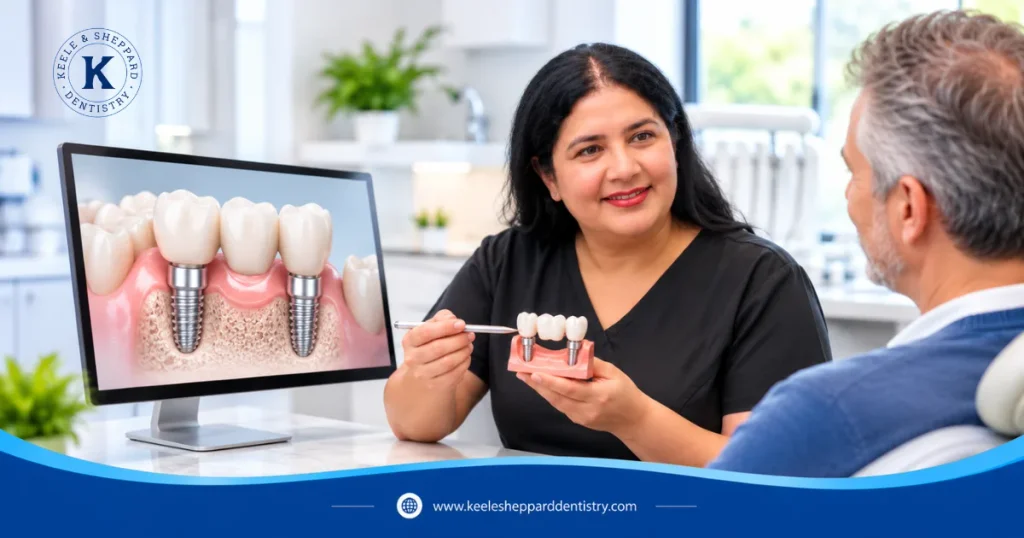
1. Assessment and 3D Planning. An exam, X-rays, and a 3D scan map your bone and plan each implant’s position. You receive a written estimate before anything begins.
2. Implant Placement. The implants are placed in the jaw under local anaesthetic, with sedation available. A temporary may be fitted while healing begins.
3. Healing and Osseointegration. Over a few months, the implants bond with your jawbone, the process that gives the bridge its stability.
4. The Final Bridge. Once the implants are secure, impressions are taken and your custom bridge is fitted, matched to your natural teeth in shape and shade.
Implant-Supported Bridge Cost Compared to Traditional Bridges
A traditional bridge usually costs less upfront, which is its main advantage. An implant-supported bridge costs more at the start because it includes the implants and surgery. Over time, though, the gap narrows: implant bridges often last longer and spare your natural teeth from the filing that can shorten their life, while traditional bridges may need replacing sooner and don’t protect the bone.
As a general guide, implant-supported bridge cost depends on the number of implants, the number of teeth, materials, and any groundwork needed. These are planning ranges, not quotes, and your exact figure is confirmed at a consultation. We bill most insurance directly, offer Beautifi payment plans, and check CDCP eligibility, since implant coverage varies.
Implant-Supported Bridges in North York at Keele & Sheppard Dentistry
At Keele & Sheppard Dentistry, we place both kinds of bridge and give you a straight recommendation between them. Our six dentists, led by Dr. Neerav J. Arora, DDS, work with our in-house oral and maxillofacial surgeon, Dr. Benjamin Cooperband, so planning and placement happen under one roof on Keele Street, near Yorkdale Mall and Highway 401. You get 3D planning, a written estimate for each option, evening and Saturday appointments, direct insurance billing, and Beautifi payment plans, from a team rated 4.9 stars from 1,700+ Google reviews.
Book Your Bridge Consultation
If you’re missing a row of teeth, a consultation shows whether an implant bridge or a traditional one suits you better, with real numbers for each. Not sure which fits? Book and we’ll check your teeth and options.
Keele & Sheppard Dentistry · 3-2800 Keele Street, North York, ON M3M 0B8 · Call 416-398-7460 · Book at keeleshepparddentistry.com/patient-scheduling · Monday to Friday 9 AM to 7 PM, Saturday 9 AM to 3 PM.
FAQs about Implant-Supported Bridges
Q1. What is an implant-supported bridge?
An implant-supported bridge replaces a row of missing teeth by anchoring to implants placed in the jaw, rather than to natural teeth. Usually two or more implants carry a bridge of three or more teeth, leaving neighbouring teeth untouched and helping preserve the jawbone beneath the gap.
Q2. Is an implant bridge better than a traditional bridge?
Each has strengths. An implant bridge protects neighbouring teeth and bone and often lasts longer, but costs more upfront and involves surgery. A traditional bridge is faster and cheaper initially but files down healthy teeth. The best choice depends on your teeth, bone, and budget.
Q3. How much does an implant-supported bridge cost?
It depends on the number of implants and teeth, the materials, and any groundwork. Implant bridges cost more upfront than traditional bridges but can last longer and protect more teeth. These are general ranges, not quotes, and your exact implant-supported bridge cost is confirmed at a consultation.
Q4. How long does an implant bridge last?
With good daily care and regular check-ups, implant bridges commonly last many years, often longer than traditional bridges. The implants themselves can last decades, while the bridge on top may need maintenance over time. Healthy gums around the implants are key to long-term success.
Q5. Does an implant bridge hurt?
Placement is done with local anaesthetic, so you feel pressure rather than sharp pain, and sedation is available. Some soreness and swelling for a few days afterward is normal and usually managed with over-the-counter medication. Most patients find recovery milder than they expected.
Q6. How many implants are needed for a bridge?
Commonly, two implants support a three-tooth bridge, with more implants used for longer spans. The exact number depends on how many teeth are missing, where, and your bone quality. A 3D scan at your consultation determines the right number for a stable, lasting result.
